

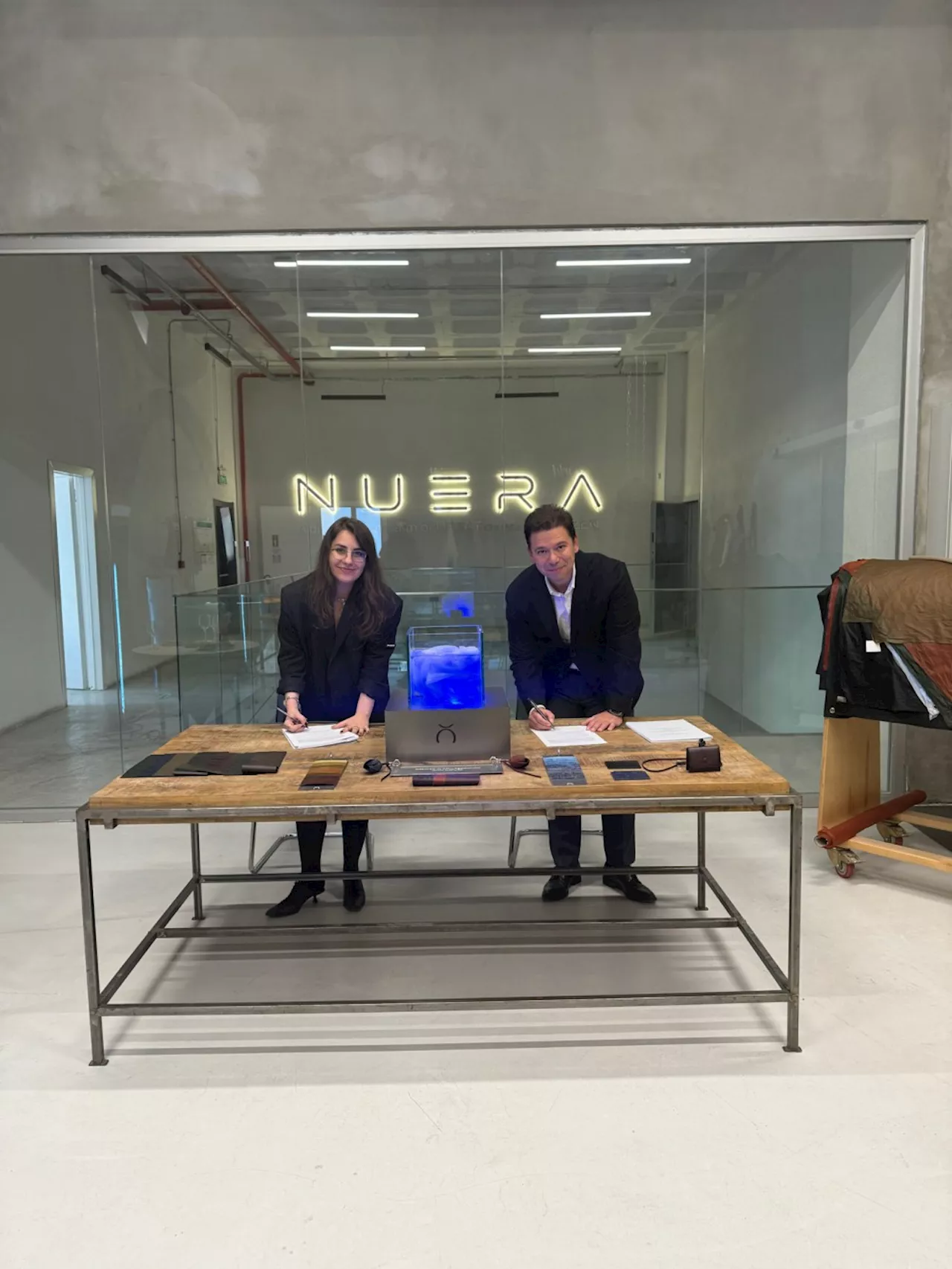
Turkish leather manufacturer Desa has launched Nuera, a new biofabrication venture created in partnership with biotechnology company Gozen. The subsidiary aims to bring "Lunaform," a next-generation biomaterial, into mass commercial production for the luxury fashion and automotive sectors.
Growing Lunaform in seven days to bypass cattle farming
The launch of Nuera represents a strategic attempt to future-proof the leather industry against shifting environmental regulations and supply chain volatility. According to the report, the traditional leather industry faces increasing pressure from global warming and changing consumer habits , which may eventually shrink the availability of animal skins. Because raising cattle typically takes at least a year, the speed of biotechnology offers a radical alternative.
Nuera’s primary material, Lunaform, offers a significantly faster production cycle, as it can be grown within just seven days. By utilizing Gozen’s proprietary BioCraft technology, the venture seeks to provide a sustainable substitute that does not rely on the meat industry's byproducts. This move comes as traditional manufacturers look to diversify their offerings before structural changes in the market become unavoidable.
Debuting on Milan runways with Lorenzo Seghezzi and Ayham Hassan
Nuera is already making its mark in the high-fashion world, having showcased its capabilities during Milan Fashion Week. For the S|Style 2026 Wardrobe Edition, designers Lorenzo Seghezzi and Ayham Hassan utilized Lunaform to demonstrate the material's versatility. Seghezzi used the biomaterial to create a structured corset and a pleated tutu, while Hassan applied it to a softer, translucent design.
Beyond the runway, the venture is moving quickly to secure industrial interest. Desa CEO Burak Çelet noted that the company is currently developing products with an additional 16 clients across the luxury and automotive industries. Unlike many biotech startups that focus solely on material science, Nuera is positioning itself as a full-service partner, offering customized development and manufacturing through Desa’s existing facilities in Turkey and Italy.
Addressing the 'credibility' issue that stalled previous innovators
The biomaterial sector has historically struggled with a "credibility gap," where promising lab-scale innovations fail to survive the transition to industrial mass prouction. As reported by the source, Burak Çelet highlighted that many previous next-gen material companies have gone under because they could not meet the physical performance or financial requirements of established markets. Nuera intends to avoid this fate by ensuring Lunaform is "plug-and-play," meaning it can be processed using conventional tannery machinery without requiring massive new capital investments.
Gozen CEO Ece Gozen emphasized that the company's strategy is to build long-term confidence rather than rushing to expand capacity. By providing brands with technical support and bespoke finishes—such as specific colors and textures—Nuera aims to move beyond simply supplying a raw material to becoming an integrated part of the luxury supply chain.
The unanswered timeline for matching petroleum-based prices
While the technical potential of Lunaform is clear, several questions remain regarding its long-term commercial viability. While Nuera aims to eventually compete with petroleum-based polyurethane alternatives, the report does not specify a timeline for when these biomaterials will reach price parity with cheaper , synthetic options. the company’s current strategy follows a "performance first, then price" philosophy, but the exact cost-reduction roadmap remains unverified.
Additionally, while the source details the material's rapid growth and compatibility with existing machines, the specific biological composition of Lunaform—whether it is mycelium-based, collagen-based, or another form of bio-fabrication—is not explicitly disclosed. For Nuera to succeed, it must prove that it can maintain high-end luxury standards while scaling to the volumes required by the automotive industry.
Comments 0