

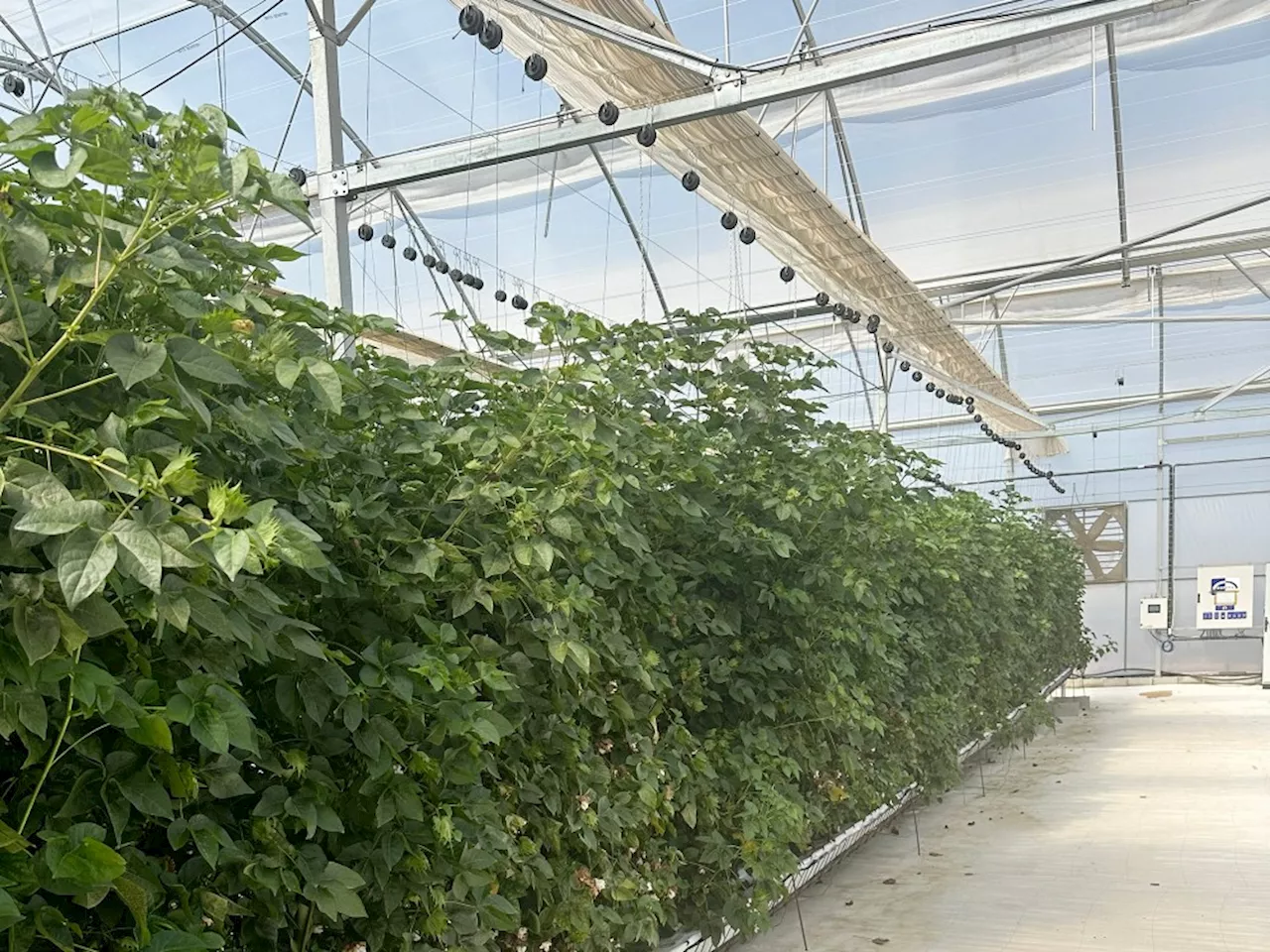
H&M Group’s Circular Innovation Lab and the Spanish hydroponic firm Magtech are collaborating to develop soil-free cotton through hydroponic technology. this experimental project uses AI-driven monitoring to grow cotton in controlled environments, aiming to reduce the heavy resource demands of traditional farming.
30,600 plants and 5 kilometers of growing channels
The scale of this new agricultural method is massive, even within a controlled setting. One hectare of the Magtech system contains approximately 30,600 plants distributed across 52 growing channels. Each of these channels is roughly 98 meters long, meaning a single walk through the system covers more than five kilometers.
Because of this complexity, the system relies on high-level technical oversight. As Magtech co-founder David René Rodríguez explained, while a skilled technician can inspect the crop , no human being is capable of observing every single plant continuously or maintaining the same level of consistency at a much larger scale. This is where the integration of technology becomes essential to the process.
AI cameras that detect pests and ripeness
To manage the vast number of plants, H&M and Magtech utilize AI-driven monitoring to boost resource efficiency. the system employs cameras to assess crop ripeness and to identify infestations at an early stage. according to the report, this precision allows pesticides to be applied only to the specific plants that require treatment, rather than blanket-spraying an entire field.
This tech-heavy approach is designed to address the envirnmental footprint of the textile industry. By using a controlled nutrient mix and recovering and reusing water, the goal is to reduce the heavy reliance on land and water that defines conventional cotton production. Martin Ekenbark, the Circular Innovation Lab lead at H&M Group, noted that AI can significantly decrease the resources required for growth .
A five-tonne batch of cotton is already in Spanish garments
This project has already moved beyond the theoretical stage and into real-world production. The first five-tonne batch of hydroponically grown cotton has successfully passed quality checks and has already been converted into garments in Spain. This proves that the fiber produced in these controlled environments can meet the standards required for commercial fashion.
The adaptability of this method is one of its most significant features. Because the system does not require fertile soil, the partners suggest that these setups could eventually be placed in unconventional locations like rooftops, car parks, or even desert environments. As long as there is sunlight and a reasonable water source, the production of cotton could theoretically happen much closer to the textile hubs themselves.
The question of whether soil-free cotton can scale economically
Despite the successful production of garments, significant questions remain regarding the commercial viability of this method. The H&M Foundation noted that current efforts have primarily demonstrated what is technically possible, rather than proving that hydroponic cotton can become a scalable, cost-effective alternative to traditional farming. it remains to be seen if the high cost of AI and hydroponic infrastructure can be offset by the savings in water and land.
There is also a vital human element to consider. David René Rodríguez emphasized that cotton supports the livelihoods of millions of farmers and workers worldwide. While the project suggests that existing farm workers could be retrained as agronomists or technicians, the industry has yet to prove how a massive shift toward soil-free farming will impact the social and economic stability of traditional farming communities.
Comments 0