

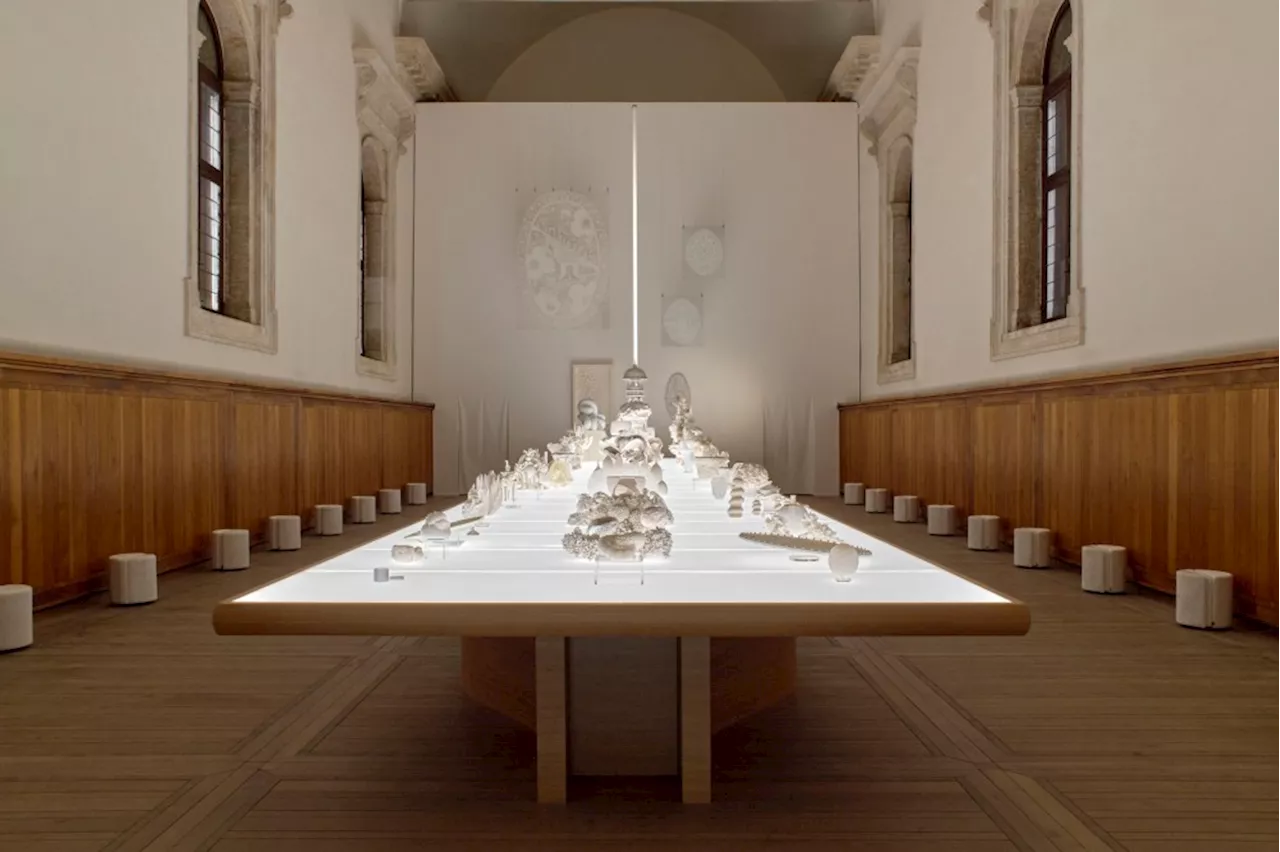
The "Homo Faber 2026: An Island of Light" exhibition is currently transforming Venice's San Giorgio Maggiore island into a sanctuary for master craftsmanship. Running until September 30, the event brings together global artisans and design houses to celebrate the intersection of manual skill and contemporary art.
Why brands like Cappellini are leaning into their "artisan DNA" in Venice
Major design houses are increasingly using the Homo Faber platform to highlight the raw, manual skill behind their luxury products. As reported by WWD, the firm Cappellini has integrated its Newood and Newood Light seating—designed by Alberto Brogliato and Federico Traverso—into the event's food and beverage spaces to emphasize its artisanal roots.
The exhibition also features high-concept installations like Giorgetti’s "The Feast of Light," which utilizes white porcelain, glass, and fabric to create a sense of purity. This collection includes nineteen Summa poufs, created by creative director Giancarlo Bosio using colors and fabrics selected by designer Es Devlin, showcasing how high design can coexist with traditional making.
Artemest’s reimagined 1940s Venetian home for the modern collector
The design platform Artemest has made a significant impact at the event by curating a space that mimics a lived-in Venetian residence. Under the direction of cofounder Ippolita Rostagno, the exhibition occupies a 1940s home formerly owned by the Toso glassmaking family,a space designed by Piero Lissoni and owned by Sanlorenzo.
This "house of reflection" serves as an immersive showroom for historic Venetian names, including glassmakers Venini, WonderGlass, NasonMoretti, and Micheluzzi Glass, alongside famed fabric houses Tessitura Bevilacqua and Rubelli. According to the report, Artemest CEO Marco Credendino designed the space to show how exceptional craftsmanship can live naturally within a contemporary interior rather than just sitting behind a museum glass case.
Fortuny’s debut wallpaper collection partners with the San Patrignano community
The event has also served as a lauchpad for new product lines that carry deep social and historical weight. The family-run firm Fortuny utilized the exhibition's momentum to release its first-ever wallpaper collection, created in collaboration with the Italian rehabilitation community San Patrignano and its Casa D’Arte project.
By employing artisans from the San Patrignano community, Fortuny has produced handcrafted effects inspired by marble, embossed leather, and lime wash.. This move highlights a growing trend at Homo Faber where luxury brands use the exhibition to showcase not just beautiful objects, but the social ecosystems and human stories that sustain traditional crafts.
Can Homo Faber maintain its focus on fine craft amidst growing design interest?
A central question remains regarding the event's identity as it attracts more mainstream design firms. While organizer Alberto Cavalli, executive director of the Michelangelo Foundation, notes that the event is not intended to be a standard design show, he admits that the quality of the master artisans' work is increasingly inspiring creative minds from the design sector.
The tension lies in whether the event can continue to prioritize the artisan over the designer. While Cavalli views the dialogue between fine crafts and decoration as a core mission, the influx of high-profile design brands suggests that the line between "fine craft" and "commercial design" is becoming increasingly blurred.
Fornasetti’s "Mani e Farfalle" motif meets Murano glassmaking traditions
Fornasetti continues its long-standing relationship with the event by exploring its deep archival history through new, tactile mediums. Artistic director Barnaba Fornasetti has focused on the "Mani e Farfalle" (hands and butterflies) motif, a poetic design that balances the natural world with human gesture.
To bring this vision to life, Fornasetti collaborated with Barbini Specchi Veneziani on the glass-making island of Murano. the resulting vase utilizes centuries-old hand-engraving techniques involving stone and diamond wheels, merging Fornasetti's distinct visual language with the rigorous technical traditions of Venetian glassmaking.
Comments 0