

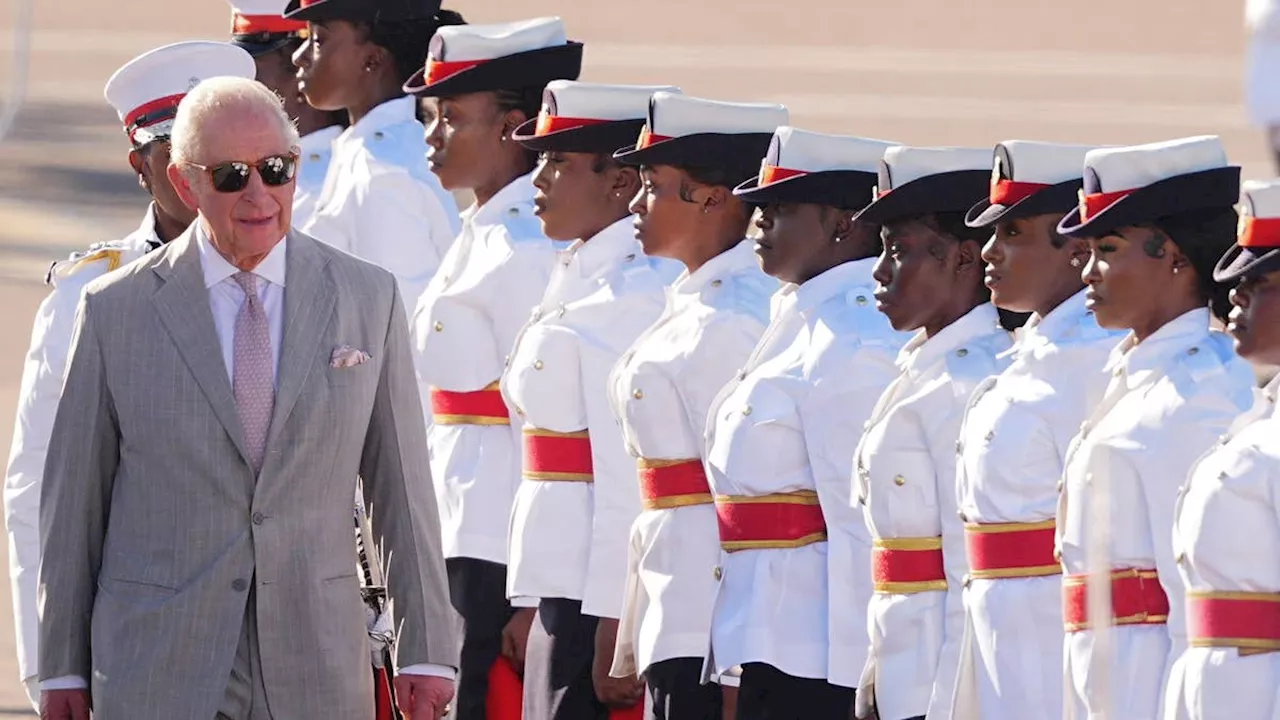
King Charles arrived in Nassau on Tuesday to begin a nine-day tour through the Caribbean, including The Bahamas, Guyana, and Antigua and Barbuda.. While he was greeted by local officials at Lynden Pindling International Airport, his visit arrives at a time of heightened tension regarding historical slavery reparations.
A 96-member Guard of Honour welcomes the King to Nassau
The 77-year-old monarch landed at Lynden Pindling International Airport just after 4pm local time aboard the British government's official Voyager plane. Dressed in a beige summer suit and sunglasses, the King was met on the tarmac by Governor-General Dame Cynthia Pratt and Prime Minister Philip E. Davis. As the report from the news service notes, the King spent much of his 10-hour flight preparing for the high-stakes visit by reading briefing papers and working on speeches.
Upon disembarking, the King was presented with a formal Guard of Honour consisting of 96 members from the Royal Bahamas Police Force and the Royal Bahamas Defence Force. Following the inspection of the guard and the playing of the national anthem, "March On, Bahamaland," the King began a convoy through the city to engage with the local community.
Protesters at Clifford Park demand "Reparations now"
The King's arrival at Clifford Park, the historic site where The Bahamas gained independence in 1973, was not without friction. A group of protesters gathered to voice their demands, holding placards that read "Pay us what you owe" and "Reparations now." The Bahamas National Reparations Committee has been vocal about the visit, warning the monarch not to arrive "empty handed."
This tension highlights a significant cultural and political divide. While the King has expressed that it is "only right" to acknowledge the great suffering of the past, the visit occurs against a backdrop of growing calls for formal apologies and financial compensation for the legacy of the transatlantic slave trade.
Can the King's words satisfy the Bahamas National Reparations Committee?
A central question remains regarding how much the King can actually achieve through diplomacy alone. While Buckingham Palace states that His Majesty is "alive to the local strength of feleing," the King is strictly bound by UK government policy. According to the report, the British government firmly rejects demands for compensation because the slave trade was not illegal at the time it occurred.
This creates several unanswered points for observers: Will the King's refusal to offer a formal apology satisfy the growing clamour for justice? Furthermore, it remains to be seen if his focus on "modern partnerships" will be viewed as a meaningful step forward or merely a way to sidestep the more difficult legal and financial questions. Any official apology from the monarch could potentially open the floodgates to billions in claims against the UK, a risk the British government is currently unwilling to take.
Empowering Bahamian youth through FEMStem and climate action
Despite the political debates, the tour has also focused on the future of the region, specifically through youth engagement and climate resilience. At the Future Bahamas Youth Rally, the King met with students such as 11-year-old Avery Davis and 13-year-old Alyssa Bain. He also visited the FEMStem Bahamas exhibition, a non-profit dedicated to empowering high school girls in science, technology, engineering, and maths.
During the FEMStem visit, the King was shown a device designed to help visually impaired people judge distances, which was constructed using recycled plastics.. This focus on innovation is particularly vital for The Bahamas, where the islands sit just two metres above sea level. The King is expected to urge young people to take up the "sacred task" of tackling the climate crisis, which he identified as a defining measure for future generations.
Comments 0