

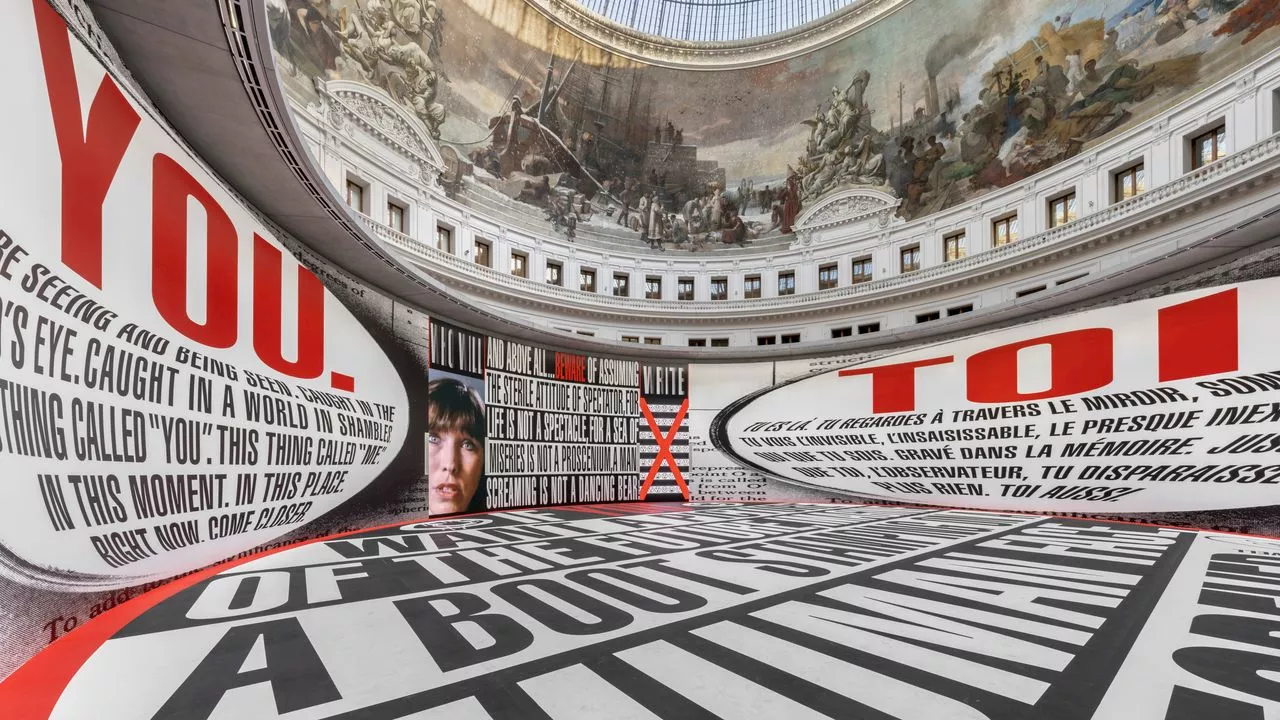
During Paris Fashion Week, artist Barbara Kruger shared her perspective on modern culture at the Bourse de Commerce in Paris. The 81-year-old creator discussed the intersection of art, politics, and the shrinking attention spans of the digital age.
From Condé Nast layouts to the Bourse de Commerce rotunda
Barbara Kruger's signature aesthetic, defined by the use of Futura Bold typeface and provocative imagery, is a direct evolution of her early professional life. Before becoming a global art icon, Kruger worked in the art department at Condé Nast, where she mastered the "paste-up" technique. This background in graphic design allows her to communicate with a brevity that she finds lacking in modern political discourse, where she notes that many public figures have lost the ability to get to the point.
The current exhibition at the Bourse de Commerce, part of the Pinault Collection, highlights this mastery through massive, "spatialized" installations. Her work features video panels and text that wraps around the concrete walls designed by architect Tadao Ando.. According to the report, these texts draw from heavy-hitting literary figures like Roland Barthes, Aimé Césaire, and George Orwell, the latter of whom provides a "chilling" vision of the future that Kruger notes is unfortunately not archaic.
The 'Supreme Bitch' fallout and the red box logo
A persistent shadow over Kruger's career is the connection between her graphic style and the streetwear giant Supreme. There has long been speculation that her work provided the blueprint for founder James Jebbia’s iconic red box logo. While Kruger has not sought legal attribution,the brand was famously involved in a lawsuit after others co-opted the aesthetic with the phrase "Supreme bitch."
Kruger’s stance on the matter is one of amused disdain.. She described the entire situation as a "ridiculous clusterfuck of totally uncool jokers," noting the irony that while many young people are intimately familiar with the Supreme brand—now owned by large conglomerates—they may not even know her name. this tension between high art and mass-marketed "cool" remains a defining theme of her legacy.
Why 81-year-old Barbara Kruger fears the 'end of eye contact'
Beyond the art world, Kruger is deeply preoccupied with the "attention economy" and the impact of digital screens on human connection. She observes that attention spans are shrinking across all demographics, a trend she believes could lead to the "end of eye contact" for future generations. This shift poses a significant threat to "durational" art—works that require sustained focus to be fully understood.
Kruger also expressed a profound skepticism regarding the potential of artificial intelligence. While she sees its utility in medicine, she remains wary of its ability to "rule us all," questioning how technology could ever truly serve a humanity it might first destroy. As the report highlights, she remains a skeptic of the idea that AI could ever achieve true consciousness.
Will her work still shock in a world of 'narcissism and voyeurism'?
As social media creates what Kruger calls a "collision of narcissism and voyeurism," the effectiveness of her confrontational style is an open question. Her installation at the Bourse de Commerce includes 24 wood-framed lightboxes beaming out aggressive orders like "Weaponize," "Monetize," and "Terrorize."
The report leaves us wondering if such direct provocations can still land with impact in an era where similar, highly charged language is a constant feature of our digital feeds. It remains to be seen whether her work acts as a necessary wake-up call or if it has simply become another piece of the performative noise that defines modern life.
Comments 0